
Overview
Neck, back and shoulder pain almost always trace back to a misaligned spine and tight surrounding tissue. We address both.
Quick takeaway
Relief from the daily aches of modern life — desk posture, training overload, and old injuries.
What it does
Here's what most patients notice from neck, back & shoulder pain — outcomes vary by case, but these are the consistent themes we see in the clinic.
- Loosens chronic tension
- Restores range of motion
- Improves posture
- Reduces inflammation
How it works
A combination of Diversified, Drop Table and Johnson BioPhysics® corrections addresses both the spinal source and the muscular compensation patterns that keep pain coming back.
In-depth guide to Neck, Back & Shoulder Pain
Neck, back, and shoulder pain are the trio of complaints that bring more patients into our Ontario, CA clinic than anything else. The pattern is so common it has become culturally invisible: the constant tightness across the upper traps, the dull ache between the shoulder blades by midafternoon, the stiff neck on waking, the dull lumbar burn after a long drive. Most people accept it as the cost of modern life. Dr. Samuel Ruiz sees it differently — these are mechanical, structural problems with mechanical, structural solutions, and the great majority of patients can feel meaningful relief without medication, injections, or surgery.
The driver in most cases is the same: prolonged static loading of the spine in postures it was not designed for. The human spine evolved for upright walking, climbing, lifting, and varied motion throughout the day. It did not evolve for ten hours a day in a chair, six hours a day on a phone, and seven hours of sleep on a mattress that does not support the natural curves. Over time, the cumulative load creates segmental restrictions, asymmetric muscle tone, postural drift (forward head, rounded shoulders, anterior pelvic tilt), and eventually the kind of pain that does not go away on its own.
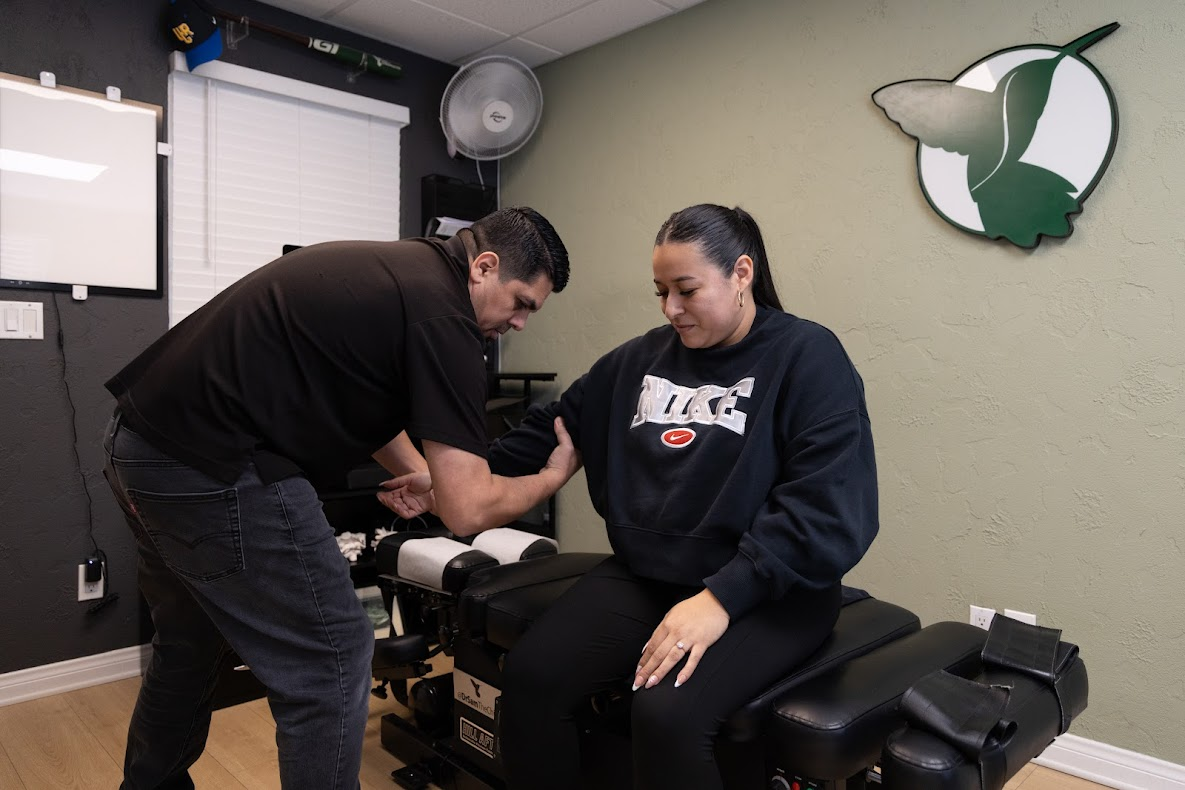
Dr. Sam's approach treats the spine and the surrounding tissue as one integrated system. Adjustments restore normal joint motion, but joint motion alone will not hold if the muscles around it are still locked in protective spasm and the postural patterns that caused the problem are still in place. Every visit therefore combines targeted spinal adjustment — Diversified, Drop Table, Johnson BioPhysics®, or Ring Dinger® depending on the case — with attention to the muscular and postural drivers that keep the pain coming back.
Cervical (neck) pain typically responds quickly. Restoration of normal upper cervical motion, combined with releasing the suboccipital and upper trapezius musculature and addressing forward head posture, often produces dramatic relief within the first few visits. Patients commonly report being able to turn their head fully for the first time in years, sleep through the night without waking from neck pain, and work a full day without the familiar afternoon tension headache.
Mid-back and shoulder pain is the signature pattern of desk workers and lifters. The thoracic spine becomes hypomobile from prolonged sitting, the scapular musculature deconditions, and the shoulder joint compensates by gaining mobility it should not have. The result is the classic combination of stiffness between the shoulder blades and impingement-pattern shoulder pain. Treatment addresses thoracic mobility first, then scapular control, then any residual shoulder joint dysfunction. Most patients are surprised at how much shoulder pain resolves once the thoracic spine is properly mobile.
Lumbar (low back) pain is the most common complaint of all and the most varied in its causes. Some patients have facet-driven pain that responds to specific lumbar adjustment. Others have disc-driven pain that responds best to decompression. Many have a combination, layered on top of pelvic and sacroiliac dysfunction. Dr. Sam's evaluation identifies which structures are driving your specific pain pattern and matches the treatment to the source rather than applying a generic 'low back protocol' to everyone.
Lifters and athletes get particular attention to the loading patterns of their sport. A powerlifter's low back pain is rarely solved by adjustment alone — it requires evaluation of squat and deadlift mechanics, hip mobility, core stability, and breathing under load. CrossFit athletes often present with thoracic and shoulder restrictions from overhead work that respond beautifully to decompression and targeted mobility. Runners frequently have pelvic and SI joint patterns that drive low back pain and that we can address in conjunction with gait analysis.
Patients travel to our clinic from Ontario, Rancho Cucamonga, Chino, Chino Hills, Upland, Fontana, Pomona, Diamond Bar, Eastvale, Corona, Riverside, San Bernardino, and across the broader Inland Empire and surrounding counties for this combination of focused, hands-on care and honest communication about what your spine actually needs. New patient appointments are $300; follow-ups are $200. Most patients are seen within a few days of calling.
Upper-quadrant pain is rarely one problem in one place. A cranky neck usually involves the upper thoracic spine, the first rib, the scapular stabilizers, and often the jaw. Dr. Sam treats the whole region in one visit rather than chasing the loudest symptom, which is why patients with stubborn 'I've tried everything' shoulder and neck pain often respond after only one or two carefully sequenced sessions.
To book, call (909) 529-1179 — wear a shirt that allows easy access to the shoulders and upper back. The clinic is at 1155 S. Milliken Ave, Suite J, Ontario, CA 91761, with free parking and direct access from the 10, 60, 15, and 71. New-patient evaluation is $300 (includes the first treatment), follow-ups $200; cash, debit, credit, and HSA/FSA all accepted.
Who it's for
Neck, Back & Shoulder Pain is a strong fit for patients dealing with:
- Desk workers
- Lifters
- Anyone with chronic upper-body tension
What to expect at your visit
- 1
Consultation & exam
Dr. Sam reviews your history, posture, and movement to find the root cause — not just the symptom.
- 2
Hands-on treatment
Your neck, back & shoulder pain session is delivered one-on-one with no rushed handoffs or assistants.
- 3
Plan forward
You leave with a clear understanding of what was done, how you'll likely feel, and whether follow-up care is recommended.
Frequently asked
Does it hurt?
Most patients describe the sensation as a deep stretch followed by relief. Dr. Sam adjusts force to your comfort.
How long is the appointment?
Plan for about 30–45 minutes. New patient visits include a full exam and may run slightly longer.
Do you accept insurance?
We're a transparent cash-pay practice. New patient $300, follow-ups $200. HSA, debit and credit accepted.